https://www.technologyreview.com/2011/03/30/196054/using-heat-to-cool-buildings
From: MIT Technology Review – Energy News 2011
Using Heat to Cool Buildings
Novel materials could make practical air conditioners and refrigerators that use little or no electricity.
By Kevin Bullis on March 30, 2011
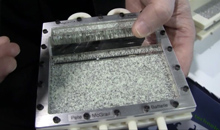
Hot pack: A display at a conference shows a new material (light green) packed into a metal foam. The material is being used to improve a technology that uses heat energy to drive a cooling process.
It could soon be more practical to cool buildings using solar water heaters and waste heat from generators. That’s because of new porous materials developed by researchers from the Pacific Northwest National Laboratory. These materials can improve a process called adsorption chilling, which can be used for refrigeration and air conditioning.
Adsorption chillers are too big and expensive for many applications, such as use in homes. Peter McGrail, who heads the research effort, predicts that the materials could allow adsorption chillers to be 75 percent smaller and half as expensive. This would make them competitive with conventional, compressor-driven chillers.
All refrigerators and air conditioners cool by evaporating a refrigerant, a process that absorbs heat. They differ in how that refrigerant is condensed so that it can be reused for cooling. Unlike the technology inside most air conditioners, which employs electrically driven compressors to mechanically compress the vaporized refrigerant, adsorption chillers use heat to condense the refrigerant. Adsorption chillers are typically far less efficient than chillers that use electrical compressors, and are bulky and expensive. But they have the advantage of being cheap to operate, since they require very little electricity. “If you have waste heat, you can run it for free,” McGrail says.
So far these chillers have been limited to applications where there is a lot of waste heat—such as industrial facilities and power plants—or where electricity isn’t always available. Cutting their size and cost could make them attractive in more applications, including in homes, where they could be run using hot water from solar heaters, McGrail says.
The key is improving the solid adsorbent material. In an adsorption chiller, evaporated refrigerant is adsorbed—it adheres to a surface of a solid, such as silica gel. [*“adsorb” is a scientific and chemical term referring to the process where atoms, ions, or molecules (from a gas, liquid, or dissolved solid) adhere to the surface of a material rather than soaking inside of it… To collect and hold a substance on the surface (like a magnet or Velcro).]
McGrail is replacing silica gel with an engineered material made by creating nanoscopic structures that self-assemble into complex three-dimensional shapes. The material is more porous than silica gel, giving it a larger surface area for water molecules to cling to. As a result, it can trap three to four times more water, by weight, than silica gel, which helps reduce the size of the chiller.
The material also binds less strongly to water molecules. That reduces the amount of heat needed to free the water molecules—making the process more efficient—and speeds up the process of adsorbing and desorbing water by 50 to 100 times, which helps make the chiller smaller. The materials also work with refrigerants other than water, which expands the temperature range at which cooling is possible.
Since current adsorption chillers can be two or three times larger than chillers that use electric compressors, “cutting the size of adsorption chillers by 75 percent could make them competitive,” says Yunho Hwang, a professor at the Center for Environmental Energy Engineering at the University of Maryland. The chillers could be particularly useful for cooling with hot water from solar water heaters, since adsorption chillers can use the relatively low-temperature such heaters produce, he says.
One challenge for such applications could be synchronizing demand for cooling with the production of heat—in some cases, it may be necessary to include a costly heat-storage system to make it possible to keep the chiller running after the sun goes down.
The PNNL researchers have been awarded $2.54 million from the Advanced Research Projects Agency for Energy to demonstrate the material in a cooling system. Under the grant, they have three years to optimize the material’s performance and incorporate it into a small demonstration chiller.
————————————————————–
Some day, BBHSP can make a small version of this type of low-heat input adsorption chiller. Then, BBHSP can have a walk-in refrigerator and chest freezers without using any electricity! (Best design??)
~~~~~~~~~~~~~~~~~~~~~~~~~~~~
https://heatcalc.com/heat-to-cooling
Heat recovery for cooling
It sounds counterintuitive, but heat can be converted into cooling or chilling duty with absorption chillers.
Benefits
Using waste heat for an existing cooling demand can displace whatever is currently being used to create the chilling. In many cases, it can displace a refrigeration or air conditioning unit that requires electricity to operate. As a result, the primary benefits are:
- Significant savings through a reduction in operating costs
- Reduction in capital spend (avoidance of a air conditioner purchase)
- Potential to monetize the heat by selling it to nearby facilities with a cooling load
- Reduction or elimination of electricity or fuel
- Reduced CO2 and other emissions
- Less price volatility
Examples of using heat to cool
Absorption cooling is most frequently used to air condition large commercial buildings. Absorption chillers can be teamed with electric chillers in “hybrid” central plants to provide cooling at the lowest energy costs. In this case, the absorption chillers are used during the summer to avoid high electric demand charges, and the electric chillers are used during the winter when they are more economical. Because absorption chillers can make use of waste heat, they can essentially provide free cooling in certain facilities. (source: US DOE)
How absorption chillers work
Absorption chillers work on the same principles as traditional, mechanical chillers. The only difference is, instead of a mechanical compressor, absorption chillers use heat to create pressure and drive the cycle. In practice the most common absorbents are Lithium Bromide and Ammonia.
There are some great resources online to dive deeper into the process of an absorption chiller:

A large industrial-sized absorption chiller.
(Due to a limited amount of excess hot water, BBHSP would only use a very small version of this system, as a demonstration system to refrigerate food in the Community Kitchen and possibly AC, depending on the size and advances in the technology…)
Technologies
Single effect chillers
These chillers have a single generator/condenser stage, which boils off the refrigerant (usually water) from the absorbent (LiBr or Ammonia). They typically operate with a lower temperature water or lower pressure steam heat source. The lower temperature means that these chillers will have a reduced efficiency compared to double effect chillers.
Double effect chillers
These chillers have two stages of generator/condenser to increase the amount of refrigerant produced, increasing efficiency compared to a single effect chiller. The high temperature stage uses the heat source boil off refrigerant while the second stage uses the vaporized refrigerant from the first stage to boil additional refrigerant. This operation requires higher temperature water or higher pressure steam.
Considerations
Absorption chillers are not for every application, but when they do fit, they can provide significant operating improvements. Some things to keep in mind as you consider an absorption chiller.
- •The cooling demand needs to occur at the same time the heat is present.
- •The temperature of the heat source (and the volume/amount of excess heat source) will dictate the chiller options.
- •Absorption chillers require some electricity to operate small pumps. Take this into account when running the numbers.
Check out our Calculator to see how much heat you have available and what you can do with it.